


The Koochiching-Washington Forest Legacy Project will protect more than 51,000 acres of forest — almost 80 square miles — in Itasca and Koochiching counties. The newly conserved lands are located near 440,000 acres of Koochiching State Forest, George Washington State Forest, Myrtle Lake Peatland State Natural Area, and Scenic State Park. The lands have been conserved through a multiple partnership and the use of state and private money totaling $12 million.
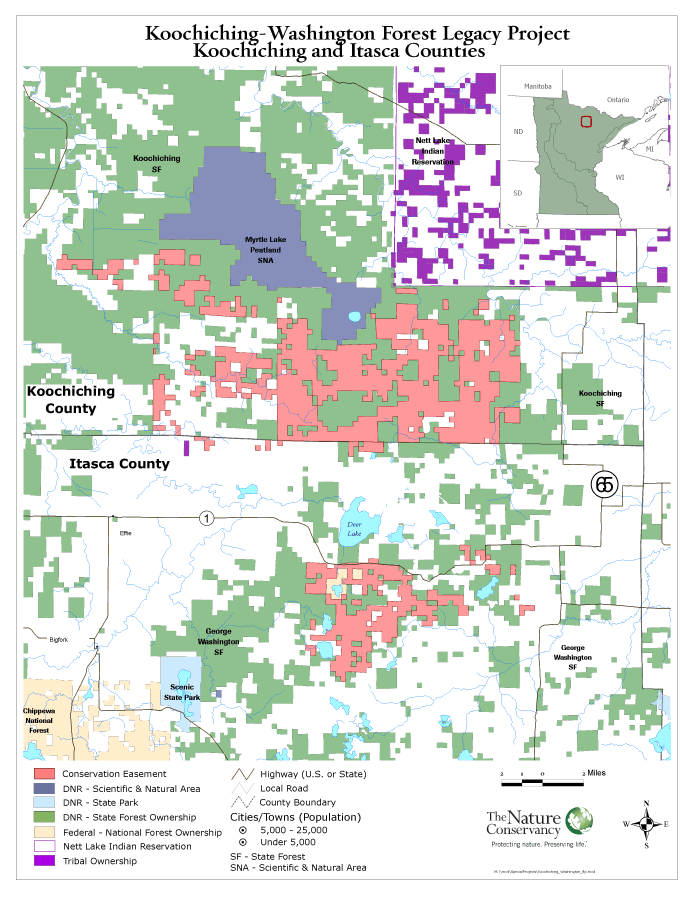
Conservation easement
Conservation easements provide a tool for keeping land in private ownership while providing conservation benefits. Voluntary land protection agreements restrict development while ensuring biological diversity, sustainable timber management, and public access.
Conservation easement agreements are needed because much of northern Minnesota is owned by industrial landowners, such as timber companies that traditionally have held large tracts of land they manage for timber. These large tracts are home to many wildlife species. In the past, many have been available for public use, providing immense opportunities for outdoor recreation. Recently, however, shifting economics for forest products and escalating real estate prices have resulted in industrial landowners selling or leasing large tracts of land resulting in fragmentation of the forest landscape.
Benefits
The newly conserved lands include coniferous forest and peatland, along with 13 lakes and more than 90 ponds totaling 46.9 miles of shoreline. The properties also encompass 43.5 miles of rivers and streams as well as 18,971 acres of wetlands.
The conservation easements in place on Koochiching-Washington Forest Legacy Project lands allow for sustainable logging while prohibiting development. The easements also ensure the lands can be used by the public for outdoor recreation, including hunting, fishing, hiking, and cross-country skiing. Snowmobiles and ATV use will continue and are subject to future trail designation on the property. The project area also includes prime lands for hunting ruffed grouse. Abundant and diverse populations of wildlife can be found in the area, including wood thrush, Canada lynx, red-necked grebe, American black duck, American woodcock, greater yellowlegs, andAmerican bittern, as well as neotropical migratory birds and other songbird species.
This project is expected to benefit as many as 81 of the 292 species classified by the DNR as species in greatest conservation need in Minnesota's State Wildlife Action Plan, "Tomorrow's Habitat for the Wild and Rare." Species in greatest conservation need are broadly defined as species that are declining, rare, or vulnerable in Minnesota.