


Working together to conserve Minnesota’s rare, declining and vulnerable species and their habitats
History of the State Wildlife Action Plan
State Wildlife Action Plans are developed by all states to provide conservation planning for Species in Greatest Conservation Need and are required by the Federal Government to access annually appropriated State Wildlife Grants. State Wildlife Grants provide funding to states to support their SGCN wildlife and habitat conservation efforts. Per Congressional mandate, SWAPs must be updated every ten years.
The first Minnesota SWAP was created in 2005. The Minnesota Department of Natural Resources’ Nongame Wildlife Program collaborated with over 250 individuals and more than 50 organizations to develop Minnesota's Wildlife Action Plan, Tomorrow's Habitat for the Wild and Rare. In 2015 the plan was updated to its second version, Minnesota’s Wildlife Action Plan 2015-2025. In 2026, the current 2025-2035 version was published; information about the prior two versions is provided below for reference.
- 2015-2025
- From 2013 to 2015 conservation partners came together again to update Minnesota's plan. MN Wildlife Action Plan, 2015-25, which includes an updated list of Species in Greatest Conservation Need, has been approved by the US Fish and Wildlife Services and replaces the 2005 plan.
Wildlife Action Plan documents
MN Wildlife Action Plan 2015-25 (overview)
MN Wildlife Action Plan 2015-25 (complete document, 240 pages)
Resources
The following Wildlife Action Network maps and associated Geographic Information System data are available to help incorporate aspects of the WAN into project planning:
Wildlife Action Network Maps
Map of the Wildlife Action Network with MN County boundaries (high resolution, 16 mb)
Map of the Wildlife Action Network with HUC 8 Watershed boundaries (high resolution, 18 mb). Additional information is available for the HUC 8 watershed boundaries .
Map of the Wildlife Action Network with ECS Subsection boundaries (high resolution, 18 mb). Additional information is available for Minnesota's ECS Subsections.
Wildlife Action Network GIS Data
The Wildlife Action Network is available in ArcMap via Quick Layers in Environmental Quality\Research and Project Focus Areas\MN Wildlife Action Plan 2015-2025.
For users external to the DNR, the WAN may be found on the MN Geospatial Commons.
A brief description of the Wildlife Action Network and the components used in its development and scoring is available.
For an overview of the concepts that informed the habitat approach and Wildlife Action Network, please see Chapter 1 and Chapter 2 in the 2015-2025 MNWAP.
For detailed information on the development of the Wildlife Action Network, please see Appendix E of the 2015-2025 Minnesota Wildlife Action Plan.
Species in Greatest Conservation Need
Minnesota's 2015-25 list of Species in Greatest Conservation Need is provided as an Excel spreadsheet that allows the user to:
Search for a Species in Greatest Conservation Need (SGCN) by its common or scientific name.
Sort SGCN by taxa, state conservation status, federal conservation status (endangered, threatened, etc.), or the criteria the species met to be included on the list of Species in Greatest Conservation Need.
The complete description of the Criteria Used by Experts to Assess SGCN is also available online.
MN Wildlife Action Plan: The Eight Required Elements
Congress identified eight required elements for each State to address in the development of its Wildlife Action Plan. This document, a supplement to Minnesota's Wildlife Action Plan 2015-2025, explains the data and methodologies MN DNR staff used to address all eight elements.
Wildlife Action Network and Conservation Focus Area Guidance
Information and examples on how to incorporate the Wildlife Action Network and reference Conservation Focus Areas in conservation projects, plans and funding proposals, is provided in two pdf formats: a narrative document, as well as a PowerPoint.
Conservation Focus Areas Status Map (2020)
Conservation Focus Areas
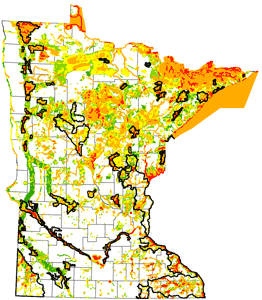
The MN WAP 2015-25 identifies a pool of 36 Conservation Focus Areas within the Wildlife Action Network. CFAs are not a prioritization of the most important areas for SGCN within the Wildlife Action Network. Rather, the identification of these areas was based on where the best opportunities may exist for working with partners to develop and implement terrestrial or aquatic habitat projects that address conservation needs, and to report on the effectiveness of management actions, which meet the WAP objectives of increasing wildlife, habitat and landscape biological diversity with a focus on Species in Greatest Conservation Need (SGCN). Because monitoring and reporting on effectiveness is resource intensive, Minnesota has committed to actively working in at least six CFAs statewide, over the ten years of the plan.
There is no regulatory or other formal authority associated with CFAs . The selected Conservation Focus Areas will address a fundamental need for states to demonstrate to Congress, the U.S. Fish and Wildlife Service and the public that Wildlife Action Plans and the State Wildlife Grants Program:
Support on the ground habitat projects: States are being encouraged to focus WAP implementation on habitat management to benefit Species in Greatest Conservation Need.
Are effective in meeting WAP goals and objectives: States are expected to report on results (both activities implemented and the effectiveness of those activities).
Involve collaboration with a broad base of partners.
Over the period of the plan (2015-2025), Ecological and Water Resources staff within the DNR Regions will meet with internal and external partners to evaluate and select Conservation Focus Areas from the pool in their region. See CFA Overviews for more information on CFAs. Information on selected CFAs will be posted on our website.
Conservation Focus Area Overview Sheets. CFA Overview Sheets provide information about target species, habitats and conservation issues and potential actions for each CFA. In addition to informing the selection of a CFA, this information may also be useful when developing or implementing conservation activities within the Wildlife Action Network. We recommend checking to see if a project or activity is within, or intersects the WAN, and if so, checking to see if a CFA Overview is available, which would provide additional information about important resources and issues in the area. Shape and Layer file of the Wildlife Action Network.
- 2005-2015
- In 2005, the Minnesota Department of Natural Resources (DNR) in collaboration with over 100 individuals and more than 40 organizations developed Minnesota's Wildlife Action Plan, Tomorrow's Habitat for the Wild and Rare. States are required by the US Fish and Wildlife Service to review and update their Wildlife Action Plans every 10 years.