

Sign up period not yet open
Volunteer signup for 2026 has concluded. Applications for the 2027 season are not yet open. Use the Community Science Bulletin sign-up form below to stay informed of opportunities in 2027. Thank you for your interest.
Minnesota Statewide FrogWatch
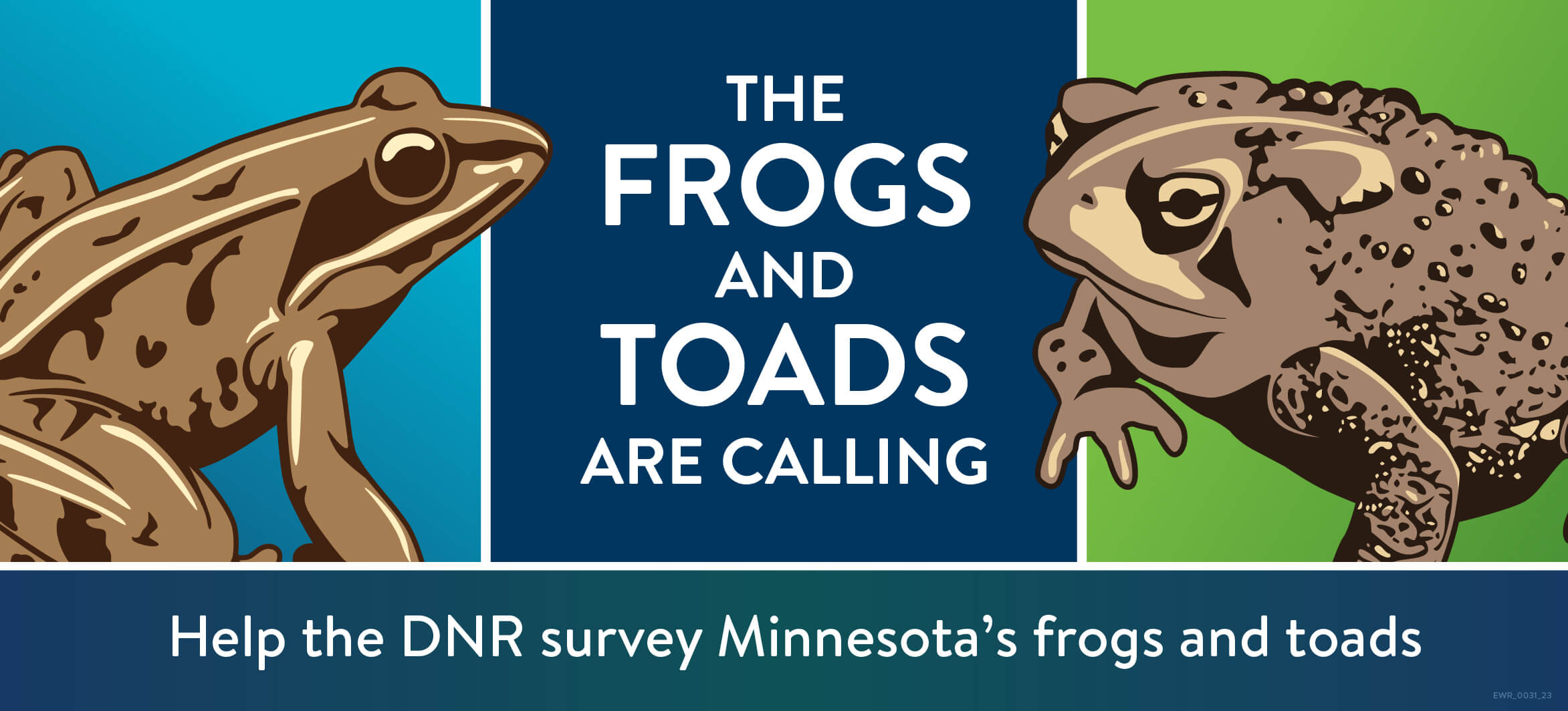
The Minnesota Statewide FrogWatch is a volunteer-based community science program led by the Minnesota DNR Nongame Wildlife Program.
Formerly the Minnesota Frog and Toad Calling Survey, volunteers have helped build one of the state’s most valuable long-term wildlife datasets—and we want you to be part of it!
Help continue a decades-long legacy of conservation and play a direct role in protecting Minnesota's frogs, toads, wetlands, and biodiversity.


What will Minnesota Statewide FrogWatch volunteers do?
Select a site: Find a wetland site you can monitor long-term and register that site online. See our FAQ on selecting a survey site for more details.
Survey your site:
Visit your site at night, at least 30 minutes after sunset.
Collect information like air temperature and cloud cover.
Listen for frogs and toads and record data about the species you are hearing.
Repeat: Return to your site every 2-4 weeks from March/April-August. Each site visit should take about 10 minutes, plus travel time.
What you will need to know or learn:
Breeding calls of all 14 Minnesota frog and toad species (we have a recorded training and more resources are available below).
How to select and register a survey site.
How to navigate to your selected site.
How to collect and enter data.
Who can participate?
Frogs and toads live throughout the state, so we need volunteers everywhere!
It’s a great fit for:
Anyone interested in frogs and toads
Families
School or community groups
Urban and rural residents alike
This program is open to anyone who can:
Learn frog and toad calls
Survey a site at least once per month during the season
Submit data online
How to get involved
Training, signup, and surveys have concluded for 2026 and we are not yet taking applications for the 2027 season. Please sign up for our Community Science Bulletin to be informed when we start getting ready for the 2027 season. Thank you for your interest!

- What is the time commitment?
- Once you have selected and registered your site, you will return to it every 2-4 weeks from March/April-August. Each site visit should take about 10 minutes, plus travel time.
- How should I select a survey site?
- Volunteers select and register their own wetland site. Because this is long-term monitoring, choose a site you can revisit year after year. Guidelines for choosing a site are covered in our trainings.
Your site should be:
In or next to frog and toad breeding habitat
All Minnesota's frogs and toads lay eggs in shallow water; suitable habitat varies by species.
Breeding habitat can include flooded fields, wetland and lake edges, ditches, and streams.
Frog and toad breeding habitat is found in urban and rural areas across Minnesota
Relatively quiet (away from heavy traffic or loud noise)
Safe and legally accessible
- How does this project help frogs and toads?
- The data creates a long-term baseline that supports targeted research, conservation planning, wetland protection and habitat management statewide.
This survey documents:
Where frogs and toads are breeding across Minnesota
How their distribution changes over time
Where species are newly appearing or disappearing
Where invasive species may be spreading
- Why do frogs & toads matter?
- Frogs and toads are essential to healthy ecosystems:
They control insect populations
They provide food for birds, mammals, reptiles, and fish
They are sensitive indicators of wetland and environmental health
Because amphibians are vulnerable to pollution, disease, invasive species, habitat loss and climate change, population declines can go unnoticed without coordinated monitoring. In a state as large and ecologically diverse as Minnesota, community scientists make this work possible.
- FAQ
- Do I need a car or other transportation to participate in the survey?
You do not necessarily need a car or other transportation to participate in the survey. While some survey sites will require transportation, your survey site can be located anywhere there is suitable habitat and a safe place to survey.
Can I participate as part of a group?
Yes! We encourage groups to participate. Surveying is fun and can be a great group or family activity.
How do I learn all of the frog and toad calls?
We cover frog and toad identification in our training, and there are resources online to help (see below.) However, the real answer to this question is that it takes practice! It can seem difficult at first, but the more you practice the easier it gets.
How do I know which frog and toad species are likely to be in my area of the state, and at what time of year?
There are great species range maps (maps that show what areas a species lives in) available through the links below.
- Resources to learn frog and toad calls
 Funding for this program was provided by the Minnesota Environment and Natural Resources Trust Fund as recommended by the Legislative-Citizen Commission on Minnesota Resources (LCCMR) and the MN DNR Nongame Wildlife Program.
This project is in partnership with FrogWatch USA.